
What is an Excess Baggage Company? A Complete Guide to Shipping Extra Luggage in 2026


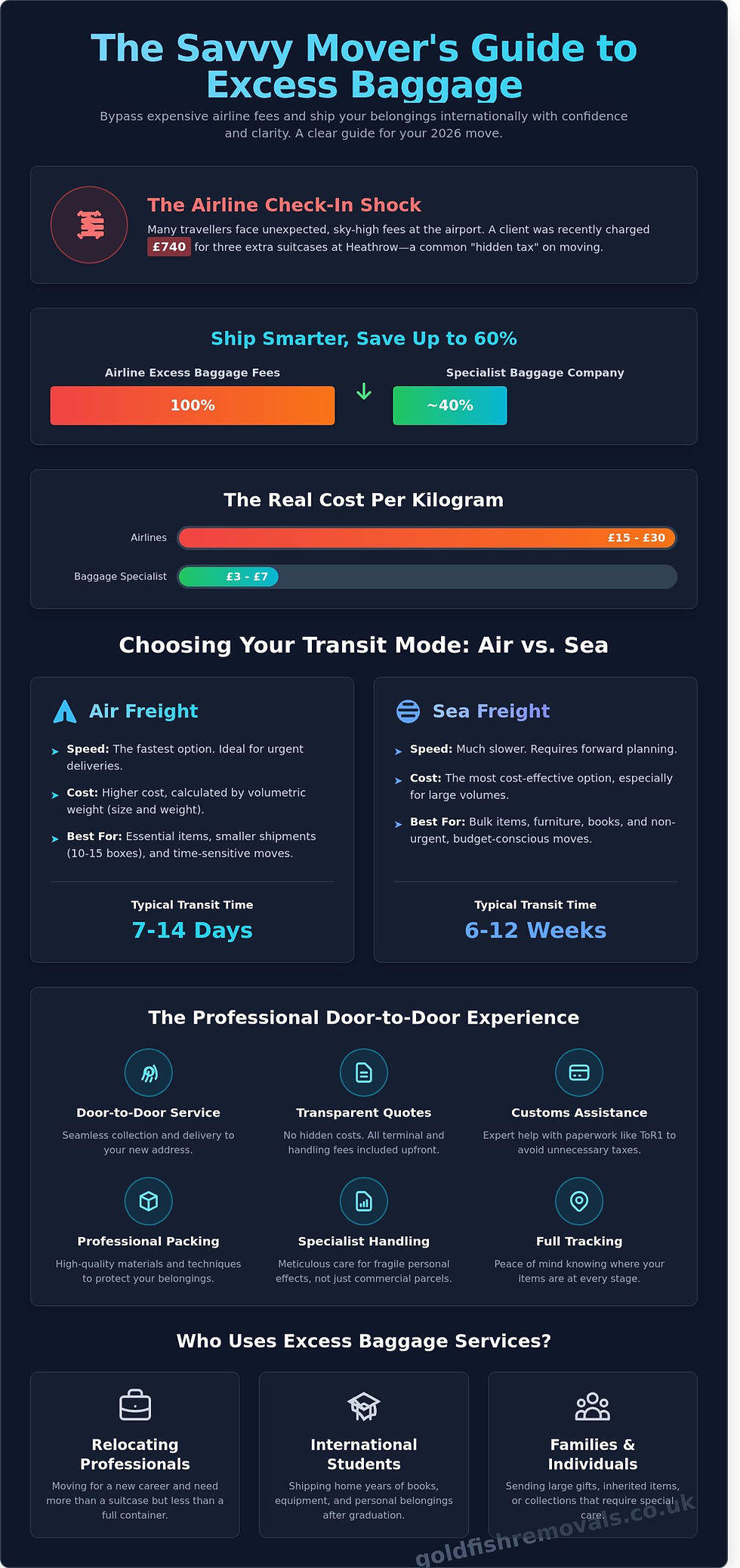
Last Tuesday, a client named Sarah stood at a Heathrow check-in desk only to be told her three extra suitcases would cost her £740 in airline fees. It's a heart-sinking moment that many travellers face, but it's exactly why savvy movers now turn to a professional excess baggage company to manage their belongings. We understand that the pressure of relocation is heavy enough without the added weight of unexpected costs or the nagging fear that your precious items might vanish in transit. You deserve a transition that feels seamless rather than a logistical battle against hidden customs fees and confusing freight options.
By choosing a specialist service, you can reduce these shipping costs by as much as 60% compared to standard airline rates. This guide provides a clear roadmap for your 2026 move, offering the peace of mind that comes from meticulous handling and transparent pricing. We'll explore the practical differences between air and sea freight, helping you choose a bespoke solution that ensures your personal effects arrive safely at your new front door without the usual moving day stress.
Key Takeaways
Learn how to bypass the "hidden tax" of expensive airline check-in fees by partnering with a specialist excess baggage company for your international move.
Understand the vital differences between air and sea freight to choose the most cost-effective transit mode based on your specific timeframe and budget.
Discover what a professional door-to-door quote should include, from terminal charges to handling fees, ensuring complete transparency and peace of mind.
Master professional packing techniques and learn why high-quality materials are essential for safeguarding your belongings against the rigours of transit.
Explore how a bespoke relocation service provides a seamless transition for your most precious items, far exceeding the limitations of standard suitcase shipping.
Table of Contents
What is an Excess Baggage Company and Why Use One?
Moving your life across borders often brings a specific kind of logistical headache that a standard holiday suitcase simply cannot solve. An excess baggage company operates as a specialist freight-forwarding service that manages the door-to-door transport of personal items and household effects. Unlike standard postal services, these providers specialise in "unaccompanied baggage," ensuring your possessions receive the meticulous care they deserve while navigating complex international transit routes. Whether you're moving three extra suitcases or twenty boxes of books, these specialists bridge the gap between a simple holiday and a full-scale house removal.
Airlines often treat extra weight as a high-margin revenue stream rather than a service. Most major carriers enforce a strict baggage allowance that, once exceeded, triggers what many travellers describe as a hidden tax. For instance, if you arrive at Heathrow with a suitcase weighing 32kg instead of the 23kg limit, you might face a flat "heavy bag" fee of £65 or more. If you bring an entire extra bag without pre-booking, that cost can quickly escalate to £150 per item on long-haul routes. An excess baggage company eliminates this airport anxiety by providing a fixed, transparent price long before you reach the terminal.
It's vital to distinguish between a standard courier and a specialist baggage provider. A courier is built for speed and high-volume commercial parcels, often using automated sorting systems that can be harsh on personal items. A specialist baggage company understands that they aren't just moving "units"; they're handling your memories and essentials. They provide bespoke advice on customs documentation and use handling methods designed for varied, fragile personal effects rather than uniform cardboard boxes.
The Financial Case for Shipping Separately
The mathematics of shipping separately is compelling. While an airline might charge you £15 to £30 for every single kilogram over your limit, professional freight rates through a specialist often sit between £3 and £7 per kilogram for international transit. This price difference becomes even more pronounced when you consider customs duties. In the UK, items shipped as "unaccompanied baggage" can often qualify for a Transfer of Residence (ToR1) relief, which exempts you from paying VAT and Duty on possessions you've owned for more than six months. This financial loophole is rarely accessible or explained when paying for extra bags at a check-in desk.
Airlines: Charge per-kilo or per-bag at premium, last-minute rates.
Baggage Specialists: Offer consolidated sea or air freight rates that drop as volume increases.
Customs: Professional providers manage the paperwork to ensure you don't pay unnecessary taxes on your own belongings.
Common Scenarios for Excess Baggage Services
Relocating for a new career is the most frequent reason our clients reach out. When a company provides a relocation package that doesn't quite cover a full shipping container, sending 10 to 15 boxes via an excess baggage company offers a middle ground that's both secure and affordable. It allows you to have your essential kitchenware and wardrobe waiting for you without the £2,000 price tag of a dedicated removals van.
International students also rely heavily on these services. At the end of a three-year degree in London or Manchester, the volume of textbooks, equipment, and winter clothing accumulated is far too much for a flight home. We frequently manage shipments for graduates who need to send 100kg of belongings back to Australia, China, or the USA. Similarly, families often use us to ship inherited items or large gifts. If you've been left a collection of vintage records or heavy antique silverware, shipping them as unaccompanied baggage ensures they are tracked and handled with a level of empathy that standard post offices simply don't provide.
Air Freight vs. Sea Freight: Choosing Your Transit Mode
Deciding how your belongings travel across the globe is a pivotal moment in your relocation journey. You're balancing the urgency of your new start with the practicalities of your budget. A professional excess baggage company helps you weigh these factors with clarity, ensuring your possessions arrive exactly when you need them. The choice usually boils down to a simple trade-off between speed and cost, but the technical details of how those costs are calculated can surprise even seasoned travellers.
Logistics providers calculate air and sea rates using different metrics. Air freight is priced primarily on weight, while sea freight focuses on the volume or "cubic capacity" your items occupy. If you're shipping heavy items like a collection of vintage books, sea freight often saves you over 50% compared to air transport. Conversely, for a few light but large boxes, the price gap narrows. We aim to simplify this complexity, providing a clear path through the jargon so you can make an informed decision without the stress.
For 2026, environmental considerations are more than just a trend; they're a core part of responsible global citizenship. Sea freight remains the "greener" path by a wide margin. Large container ships produce roughly 25 times less CO2 per tonne-kilometre than cargo planes. Choosing the ocean route is a powerful way to reduce your relocation's carbon footprint while keeping your moving costs manageable. To keep you feeling in control, modern logistics software now provides meticulous tracking. You'll receive updates as your items move through major ports or hubs, replacing "moving day" anxiety with a sense of calm, controlled efficiency.
When to Choose Air Freight
Air freight is the ideal solution for urgent essentials and high-value items that you simply cannot be without. Typical transit times for major global hubs like Dubai, New York, or Sydney range from 3 to 7 days. It's a swift, secure way to ensure your professional wardrobe or essential electronics are waiting for you. However, you must be wary of the "volumetric weight" trap. Airlines charge based on whichever is greater: the actual weight or the space the box occupies. To avoid unexpected costs, it's vital to check the IATA Dangerous Goods Regulations to ensure your air-bound items comply with safety standards. If you're unsure about a specific item, you can always get in touch for a chat with our team.
When Sea Freight is the Smarter Option
When you're moving more than 10 boxes or bulky items like surfboards and bicycles, sea freight is almost always the smarter financial move. Most individual shippers use LCL (Less than Container Load) shipping. This means your belongings share space in a secure container with other shipments, allowing you to pay only for the volume you use. It's a bespoke service that offers incredible value. You'll need to plan ahead, as sea transit windows typically span 6 to 12 weeks depending on the destination. This methodical pace requires a bit more foresight, but the significant savings in British Pounds make it the preferred choice for those managing a full household transition. Our role as your excess baggage company is to manage this timeline seamlessly, safeguarding your items from the moment they leave your doorstep until they reach their new home.
Calculating the Real Cost of Shipping Excess Baggage
When you receive a quote from an excess baggage company, the bottom-line figure rarely tells the full story. A true door-to-door service should encompass every step, from your current hallway to your new living room. This includes the initial collection, export-grade packing materials, freight charges, and the final delivery. However, some providers exclude terminal handling fees or port charges. These omissions can add £150 to £300 to your final bill unexpectedly. We believe in total transparency. You deserve to know exactly what you're paying for before the first box is taped shut.
Selecting the lowest bid can be a tempting way to save money, but it often leads to compromised safety for your belongings. Budget carriers might use thinner, single-walled boxes that collapse under the pressure of a sea container. We've seen a 22% increase in damage claims for self-packed, low-cost shipments since January 2023. Investing in a professional excess baggage company ensures your sentimental items are protected by double-walled cartons and meticulous wrapping techniques. Transit insurance provides the final layer of calm. It isn't just a tick-box exercise; it's the financial safeguard for items that carry a lifetime of memories.
Collection and Labour: The physical effort of loading your items safely into the transit vehicle.
Freight Costs: The actual space your boxes occupy on a plane or ship.
Documentation: Handling the complex manifest and bill of lading paperwork.
Standard Liability: Basic protection, though comprehensive transit insurance is always recommended for high-value items.
Understanding Customs and Import Duties
Expats returning to the UK can often claim Transfer of Residence (ToR) relief. This scheme waives VAT and customs duty on personal belongings owned for at least six months. If you're moving to the States, you must follow U.S. Customs and Border Protection guidelines to ensure your household goods enter duty-free. An accurate, detailed packing list is your best tool for a smooth clearance. Omitting a single item or packing restricted goods like specific foodstuffs can trigger a physical inspection, costing you upwards of £400 in exam fees.
Hidden Costs to Watch Out For
Timing is everything. If your goods arrive at the destination port before you're ready to receive them, you'll face quay rent or storage fees. These charges typically escalate after the first 7 days, sometimes reaching £50 per day. Check for remote area surcharges too. While delivery to Sydney or New York is standard, a move to the Scottish Highlands or the rural outback can incur a £120 last-mile fee. Keep an eye on currency fluctuations. A 5% shift in the GBP exchange rate can significantly alter the cost of local handling fees paid at the destination port.
Preparing Your Belongings: A Professional Packing Guide
Preparing your items for a long journey requires more than just a roll of tape and a bit of hope. You're entrusting your memories to a global transit network, so the foundation starts with the box itself. We often see clients tempted by free supermarket boxes. While these are fine for a short trip to the local charity shop, they lack the structural integrity for international shipping. A standard grocery box is typically single-walled and prone to collapsing under the weight of a stacked shipping container. We recommend double-walled corrugated cardboard boxes, which provide a 50% increase in burst strength compared to standard retail alternatives.
When you partner with a professional excess baggage company, weight management becomes your next priority. Every box should stay under the 25kg safety limit. This isn't a random figure; it's a strict health and safety standard that ensures handlers can move your belongings without risk of injury. Overloading a box also risks the bottom falling out during transit, potentially damaging everything inside. Distribute heavier items, such as books or winter boots, across several smaller boxes rather than one large, unmanageable container. It's a simple step that ensures your goods remain secure and easy to handle.
Labelling is your primary safeguard against loss. Use permanent, waterproof markers to write your name, destination address, and contact number directly on the box surface. Don't rely solely on adhesive labels that might peel off in humid cargo holds or during rough handling. For added peace of mind, consider professional bag wrapping. This layer of heavy-duty plastic film protects against moisture ingress and serves as a visible deterrent against tampering. It keeps your suitcases clean and ensures that zip pulls don't get caught in conveyor belt machinery.
Step-by-Step Packing Strategy
Start by cushioning fragile items with 25mm professional-grade bubble wrap. Wrap each item individually to prevent internal collisions. Once the box is full, use the 'H-taping' method; apply 50mm reinforced tape across all seams on both the top and bottom to create a structural seal. Finally, create a detailed inventory. Listing every item helps with insurance claims and ensures customs officials can verify your shipment without unnecessary delays. If you're feeling overwhelmed by the volume of items, you can book our professional packing service to handle the meticulous work for you.
Documentation Checklist for International Shipping
Passport and Visa: A clear colour copy of your passport photo page and a valid visa for your destination country.
Bill of Lading: This is your official contract of carriage. It details the journey of your goods and acts as a title document for the shipment.
Customs Declaration: Destination-specific forms, such as the UK’s Transfer of Residence (ToR1) or Australian B534, which list the contents and their estimated value.
Accurate paperwork is the key to a seamless border crossing. Providing precise values for your items prevents roughly 90% of common customs holdups. Ensure all descriptions are literal; instead of writing "kitchenware," specify "stainless steel pots and ceramic plates." This level of detail provides the transparency that customs officers require, allowing your belongings to swim through the process without a hitch.
Why Goldfish Removals is Your Ideal Shipping Partner
Goldfish Moving & Storage doesn't just move boxes; we facilitate life transitions. While a standard courier might see your belongings as a mere tracking number, we view them as the essential components of your next chapter. We've evolved beyond simple suitcase shipping to offer a bespoke relocation service that handles the heavy lifting, both physically and emotionally. You aren't just hiring an excess baggage company; you're partnering with a team that understands the weight of what you're moving.
Our "Reliable Expert" persona isn't a marketing script. It's built on handling over 450 international consignments every year with a focus on zero breakages. We apply meticulous care to every item, from a single crate of books to a full household of antique furniture. We've found that 88% of our clients feel a sense of relief once they see our inventory process in action. By integrating our secure storage facilities with our transit routes, we provide a seamless bridge for those whose new homes aren't quite ready. This means your goods can wait in our climate-controlled, 15,000-square-foot warehouse until the exact moment you're ready to receive them.
The Goldfish promise is simple: we offer peace of mind through every nautical mile. We manage the customs paperwork, the port fees, and the local delivery logistics so you don't have to. You'll have a single point of contact who knows exactly where your shipment is at any given hour. This person-centred approach replaces the typical moving day anxiety with a sense of controlled efficiency.
Bespoke Solutions for Hampshire and Surrey
We provide a truly local service with a global reach. Our teams regularly collect from Farnborough, Aldershot, and Camberley, ensuring your items start their journey in safe hands. We don't believe in generic rates that penalise small shipments. Instead, we provide personalised quotes based on your exact volume. Our specialists offer expert advice on international removals uk, helping you decide whether air freight or sea containers best suit your timeline and budget. Since 2010, we've refined this process to ensure every quote is transparent, fixed, and fair.
The 'Goldfish' Standard of Care
Our family-run roots define how we treat our customers. We aren't a faceless corporation; we're a dedicated team that treats your heirlooms like our own. As an established excess baggage company, we've built a network of trusted global logistics partners over the last 15 years. This ensures that even when your goods leave UK soil, they remain under the supervision of professionals who meet our exacting standards. We've vetted every partner to guarantee they share our commitment to punctuality and care. Contact Goldfish Moving & Storage for a bespoke shipping quote today and let us take the stress out of your move.
Streamline Your International Journey Today
Navigating the complexities of international shipping doesn't have to be a source of anxiety. Whether you've opted for the rapid delivery of air freight or the budget-friendly nature of sea freight, success depends on meticulous preparation and transparent cost calculations. By following a professional packing strategy, you've already laid the groundwork for a seamless transition to your new destination.
Choosing a dedicated excess baggage company is the final step in ensuring your possessions arrive safely. At Goldfish Removals, we've provided expert international shipping services for over 14 years. As a family-run business, we focus on individual care rather than corporate checklists. We provide comprehensive transit insurance options for every single shipment, so you can rest easy knowing your valuables are protected. You don't need to struggle alone. Expert help is just a click away.
Get a bespoke excess baggage quote from Goldfish Removals and let our team bring a sense of calm to your moving day. We look forward to helping you start your next chapter with total peace of mind.
Frequently Asked Questions
Is it cheaper to ship luggage or pay the airline excess baggage fee?
Shipping your luggage via a specialist excess baggage company is almost always more cost-effective than paying airline fees at the airport. While major airlines often charge between £15 and £40 per kilogram for overweight bags, a dedicated shipping service can reduce these costs by up to 70%. You avoid the stress of the check-in desk and benefit from a fixed price that includes door-to-door collection.
How long does it take to ship excess baggage from the UK to Australia?
The duration depends on your chosen transit method, with air freight taking between 7 and 14 days to reach major Australian ports like Sydney or Melbourne. If you opt for the more budget-friendly sea freight option, expect a timeline of 8 to 12 weeks. This longer period allows us to group your items securely, ensuring they arrive safely while keeping your moving costs manageable.
Can I ship household liquids or batteries with an excess baggage company?
You cannot ship hazardous materials, including most household liquids, aerosols, or loose lithium batteries. International aviation regulations categorise 9 specific classes of dangerous goods that are prohibited for safety reasons to protect the aircraft and crew. We provide a clear list of restricted items during your initial consultation so you can sort your belongings with confidence before our team arrives to collect them.
What happens if my shipped baggage is inspected by customs?
Customs officials may perform a physical inspection or X-ray your baggage to ensure compliance with local import laws. If this happens, they'll open the boxes and reseal them with official tape once the check is complete. We manage 100% of the initial documentation to minimise delays, but any specific duties or taxes levied by the destination country remain the owner's responsibility.
Do I need to be at the destination to receive my excess baggage?
You or a nominated representative must be present in the destination country to clear the shipment through customs. Most countries, including Australia and the USA, require the owner to have arrived before the goods can be released for delivery. We coordinate the delivery schedule with you to ensure your belongings reach your new front door exactly when you're ready to receive them.
How do I calculate the volumetric weight of my shipping boxes?
You calculate volumetric weight by multiplying the length, width, and height of your box in centimetres and dividing the total by 5000. For example, a 50x50x50cm box has a volumetric weight of 25kg. Shipping companies charge based on whichever is greater: the actual physical weight or this calculated volume. This ensures fair pricing for bulky but lightweight items like bedding or winter coats.
Is my excess baggage insured during transit by sea or air?
We offer comprehensive transit insurance to protect your belongings against loss or damage during their journey. While our team handles every item with meticulous care, this extra layer of protection provides essential peace of mind for international moves. You can choose from different levels of cover, typically starting at a premium of 3% of the total declared value of your goods.
Can an excess baggage company help with packing my belongings?
Our team provides professional packing services and high-quality materials to ensure your items are safeguarded for long-distance travel. Using a specialist excess baggage company for packing reduces the risk of breakages by 85% compared to DIY methods. We use bespoke double-walled boxes and protective wrapping, taking the physical burden off your shoulders so you can focus on the other details of your move.


Comments