
Protecting Furniture Corners When Moving: The Professional Guide to Damage-Free Relocation


What if the difference between a pristine heirloom and a chipped disaster isn't the thickness of your bubble wrap, but the "buffer zone" you create beneath it? Moving home is a significant emotional and logistical undertaking, and it's natural to feel a sense of trepidation as your favourite items are manoeuvred through narrow doorways. You want to ensure that every edge remains as sharp and flawless as the day you bought it, yet the variety of foam and plastic guards can feel overwhelming. Protecting furniture corners when moving is less about the specific guard you purchase and more about the professional layering techniques used to secure them.
We understand the pressure of keeping your home's history intact during a transition. In this guide, you'll discover the professional methods used by expert movers to guarantee your furniture arrives in the same condition it left. We'll provide a clear shopping list of British-standard materials, from impact-resistant cardboard to high-grade moving blankets. You'll also learn a fool proof method to secure these protectors so they don't budge whilst in the van, providing the controlled efficiency you need for a calm, successful relocation.
Key Takeaways
Understand why corners bear the brunt of impact during tight manoeuvres and how to prevent costly veneer delamination.
Identify the essential professional materials needed for a secure move, including heavy-duty polyethylene foam profiles and double-walled edge guards.
Master the "Goldfish Layering Technique," a foolproof method for protecting furniture corners when moving that ensures your protection never slips or shifts.
Learn specialised care requirements for antiques and glass, such as using breathable materials to avoid finish clouding on delicate surfaces.
Discover strategic loading secrets to create secondary "buffer zones" within the moving van by utilising soft household items like linens and cushions.
Table of Contents
Why Furniture Corners are the Most Vulnerable Point During a Move
Corners are the Achilles' heel of any relocation. Whilst the flat surfaces of a dining table or wardrobe are relatively easy to shield, the sharp angles are where physics works against you. During a move, the entire weight and momentum of a heavy object often concentrate into a single point of contact. If a sideboard clips a doorframe, that tiny area absorbs 100% of the force, leading to what professionals call "impact gouges" rather than simple surface scratches. Understanding the vulnerability of these points is the first step in protecting furniture corners when moving effectively.
The material of your piece also dictates the severity of the damage. For solid wood items, which have played a central role throughout the history of furniture, a knock might result in a dent that requires professional steaming or sanding. However, modern veneered pieces face the "Veneer Problem." A sharp impact often causes delamination, where the thin decorative layer peels away from the compressed substrate. This type of damage is notoriously difficult to hide and often requires expensive specialist intervention to restore the original aesthetic.
The "Pivot Point" Danger in Narrow Hallways
Most damage occurs when navigators encounter 90-degree turns. In the narrow hallways typical of older homes in Surrey, large items like desks or sideboards require complex "pivot" manoeuvres. Professional movers in Farnborough mitigate this by mapping out the transit path before lifting a single item. They identify "wall-strike" zones where a corner is likely to make contact with a doorframe or radiator. High-risk pieces like dining tables and heavy desks are particularly prone to these collisions because their corners often sit at the exact height of door handles and skirting boards.
The Cost of Repair vs. The Cost of Protection
Repairing a damaged corner is rarely a simple task. Matching wood stains on a corner repair is incredibly challenging because the grain direction changes at the edge, making the patch stand out. For contemporary high-gloss finishes, "shabby chic" touch-ups simply won't work; the repair will always remain visible to the eye. Structural integrity is also a concern for flat-pack furniture. If a corner is crushed, the internal particle board loses its density, often making it impossible to re-tighten the original screws or cams. Proactive protection costs a fraction of professional French polishing services.
Essential Materials for Professional-Grade Corner Protection
The right equipment transforms a stressful relocation into a controlled, professional process. Whilst it is tempting to rely on household substitutes like old towels or duvets, these materials often lack the density required to absorb kinetic energy during transit. True protection relies on a combination of specialised buffers and secure fastening techniques. By investing in professional-grade packing materials, you provide your most cherished items with a defensive shield that household linens simply cannot match.
Heavy-duty polyethylene foam profiles are the gold standard for protecting furniture corners when moving. These come in two primary shapes: L-profiles for standard 90-degree edges and U-profiles that "clip" onto thinner surfaces. These profiles are designed to stay in place under pressure, providing a consistent cushion that won't compress or slip. To secure these guards, professionals use industrial-grade stretch wrap rather than tape. This leads to the most important rule of relocation: the "No-Tape" Rule. Adhesive should never touch the furniture surface directly. Tape can pull away delicate finishes or leave behind a stubborn residue that requires harsh chemicals to remove, potentially leading to the veneer damage discussed in the previous section.
Foam Profiles vs. Plastic Guards
Many retailers suggest clear plastic baby-proofing guards for moving, but these are designed for static safety rather than the rigours of a moving van. Foam is superior for shock absorption because its cellular structure collapses slightly on impact, dissipating the force. Plastic guards are often too rigid; they might prevent a scratch, but they transfer the full energy of a collision directly into the furniture frame. For glass table tops or thin desk edges, a snug-fitting U-profile foam guard is essential. If you are based in the Aldershot or Fleet area, sourcing these industrial-grade foams from specialist suppliers ensures you have the same toolkit as the experts.
The Role of Corrugated Cardboard
If you cannot source foam profiles, double-walled corrugated cardboard is an excellent alternative. You can create your own buffers by cutting spare packing boxes into strips and folding them into multi-layered triangles. This utilises the "Crumple Zone" theory. Just like a car's bumper, the cardboard is designed to crush and deform upon impact, absorbing the energy before it reaches the wood or glass. Pairing a cardboard outer layer with a foam inner layer creates a "hard-soft" hybrid that offers the highest level of protection against both sharp gouges and heavy impacts. Using high-tack packing tape only on the outside of the cardboard ensures the furniture remains untouched by adhesive.
The Goldfish Layering Technique: A Step-by-Step Guide
Professional movers don't just "wrap" an item; they build a structured defence system around it. This methodical approach, which we call the Goldfish Layering Technique, ensures that every impact is absorbed by the materials rather than the furniture itself. It is the industry standard for preventing transit-related corner chips and ensuring total peace of mind during your relocation. Following this specific order of operations is the most effective way of protecting furniture corners when moving.
Step 1: Clean and dry the surface. Use a soft, lint-free cloth to remove every trace of dust or grit. If debris is trapped beneath a corner protector, the vibrations of the moving van will turn that dust into sandpaper, leaving permanent swirl marks on your finish.
Step 2: Apply the primary buffer. Fit your foam U-profiles or cardboard edge guards directly onto the corners. These act as the first line of defence against direct impacts.
Step 3: Envelop the piece in a professional moving blanket. Drape a thick transit wrap over the entire item. Unlike household duvets, these blankets are specifically woven to resist tearing and provide uniform padding across the surfaces and edges.
Step 4: Secure with stretch wrap. Wrap industrial-grade plastic film around the blanket and the corner protectors. This binds the layers into a single, immobile unit that won't shift whilst being manoeuvred through doorways.
Step 5: External labelling. Clearly mark the wrap with "Fragile" or "Top Load Only" using a bold marker. This provides a visual cue for the loading team to prioritise the safety of these specific edges.
Securing the Buffer Without Damaging the Finish
The biggest mistake DIY movers make is using packing tape to hold foam guards in place. To avoid adhesive residue, use the "Tape-to-Tape" method. First, wrap a layer of stretch wrap around the furniture leg or edge. Place your protector on top, then use tape to secure the guard to the plastic film itself. This ensures no adhesive ever touches the wood. The Goldfish Layering Technique is the industry standard for preventing transit-related corner chips. If you feel overwhelmed by the technicalities of this process, our Expert Packing Services for Your Farnborough Move can handle the entire sequence for you, ensuring every heirloom is professionally shielded.
Using Stretch Wrap Like a Pro
Stretch wrap is a powerful tool when used with the right amount of tension. As you pull the wrap, it naturally tightens, drawing the corner protectors snugly against the frame. However, you must be mindful of "sweating." Plastic wrap is non-breathable; if you leave it on solid wood furniture for long periods in a non-climate-controlled environment, moisture can become trapped, leading to clouding or "blooming" of the varnish. Always remove the plastic layers as soon as the item is safely inside your new home to let the natural materials breathe again.

Special Considerations for Antiques, Glass, and Pianos
Whilst the Goldfish Layering Technique provides a robust foundation for most household items, certain possessions require a more nuanced approach. High-value antiques, expansive glass surfaces, and heavy instruments like pianos present unique challenges that standard packing materials cannot always resolve on their own. When protecting furniture corners when moving these specialist pieces, you must account for chemical reactions, extreme weight distribution, and the specific structural vulnerabilities of the materials involved.
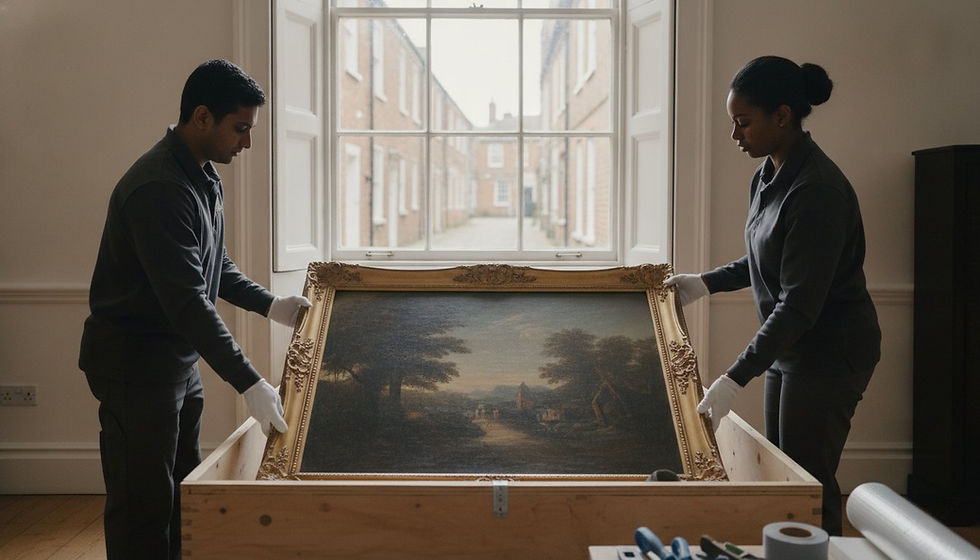
Pianos, for instance, possess an immense weight that can cause standard polyethylene foam to collapse completely. If the foam is compressed to the point of being flat, it loses its ability to absorb shock during transit. In these instances, professionals utilise high-density blocks or custom-built timber crates to ensure the corners never make contact with a hard surface. For mirrors and framed fine art, we often employ the "Box-within-a-Box" method. This involves shielding the corners with foam, placing the item in a fitted box, and then suspending that box inside a larger container filled with shock-absorbing void-fill to create a floating buffer zone.
Delicate Antiques and French Polished Surfaces
Antique furniture often features delicate finishes like French polish or beeswax, which are highly susceptible to "clouding" if moisture or heat is trapped against the wood. To prevent this, your first layer must be breathable. We recommend using acid-free tissue paper or soft cotton wraps as a primary barrier before applying any secondary buffers. Never apply bubble wrap directly to a polished surface. The plasticisers in the bubbles can react with the finish over time, leaving permanent "polka dot" indentations that are incredibly difficult to restore. For those with significant collections, our Fine Art & Antique Moving in Surrey service provides the specialist care and materials these items deserve.
Glass and Mirrored Corners
Glass is surprisingly resilient on its face but incredibly fragile at its edges. A single sharp impact to a corner can cause a "tempered shatter," where the entire pane disintegrates instantly due to the release of internal tension. To mitigate this risk, L-shaped cardboard guards are non-negotiable for mirrors and glass tops. These guards should be combined with the "Criss-Cross" tape method. By applying high-tack tape in an 'X' pattern across the glass surface, you reduce vibrations and provide better stability whilst the corner protectors are being secured. If you're managing glass-fronted cabinets during a move in Guildford, ensure the internal shelves are removed and packed separately using the same edge-protection logic. If you're concerned about handling these high-risk items yourself, you can arrange our professional packing services to ensure every fragile edge is expertly managed.
Loading Strategies: Protecting Corners in the Moving Van
Once your items are wrapped using the layering technique mentioned earlier, the final challenge is the journey itself. Protecting furniture corners when moving doesn't end at your front door; it continues inside the removal vehicle. Think of the van interior as a high-stakes puzzle where every piece must fit snugly to prevent movement whilst leaving enough "breathing room" to avoid friction. It's about total stability. A well-organised load ensures that the momentum of the vehicle doesn't turn your furniture into a series of colliding weights.
Use soft household items to your advantage during the loading process. Bags of linens, cushions, and duvets make excellent secondary buffers between larger furniture pieces. If a dining table corner is securely wrapped in foam, placing a bag of spare towels next to it adds an extra layer of shock absorption. Always secure heavy items with tie-down straps, often called lashing. These straps prevent the load from sliding during braking or cornering. For desks and tables, an upright orientation is usually superior to laying them flat. When flat, the weight of the piece is distributed across the legs or corners in a way they aren't designed to handle, whereas upright placement keeps the stress on the structural frame.
Creating "Buffer Zones" in the Load
Moving blankets should be used as spacers between heavy items to prevent vibration rub. This is especially important for long journeys across Hampshire, where constant road vibrations can cause even the most secure wrap to chafe against a neighbouring item. You should never place a heavy box directly on top of a protected corner. The concentrated pressure can crush even the highest quality foam buffer, leading to the very damage you worked so hard to prevent. Instead, stack boxes of similar weight together and keep them away from the delicate edges of your furniture.
When to Call in the Professionals
Recognising when a piece is too heavy or complex for DIY corner protection is a sign of a well-planned move. If you are dealing with grand pianos, bespoke office furniture, or oversized wardrobes, the risk of damage often outweighs the benefits of a self-managed move. Professional movers bring the experience of hundreds of successful transits, knowing exactly how to balance a load for maximum safety. Along with this, the benefit of professional transit insurance provided by Goldfish Moving & Storage offers a layer of financial security that DIY moves lack. We take pride in our controlled, efficient approach to every relocation. Contact Goldfish for a stress-free, professional moving quote today.
Moving Forward with Confidence and Care
Relocating your home marks the start of a new chapter; ensuring your most cherished items arrive unscathed is paramount to a stress-free transition. By mastering the Goldfish Layering Technique and utilising professional-grade materials like polyethylene foam and transit blankets, you've taken the most important steps in protecting furniture corners when moving. Remember that the "No-Tape" rule is your best defence against finish damage, whilst strategic loading within the van creates the necessary buffer zones for a smooth journey across Hampshire and Surrey.
If the logistical burden of a full-scale move feels overwhelming, we're here to help. As a family-run business with over a decade of experience, we prioritise personal care and reliability in every project. We utilise specialist equipment for piano moving and fine art transport, ensuring even the most complex items receive the attention they deserve. You don't have to manage the "Tetris" of a moving van alone. Get a Fixed-Fee Quote for Your Professional Move and let our seasoned professionals handle the heavy lifting whilst you focus on settling into your new home. We look forward to making your next move your best one yet.
Frequently Asked Questions
Can I use bubble wrap to protect furniture corners?
You can use bubble wrap, but it should only serve as a secondary layer of padding. The air bubbles often pop under the intense, concentrated pressure of a sharp furniture corner during a collision. For the best results, apply a rigid foam profile or cardboard guard first, then use bubble wrap to provide additional surface protection. Never apply bubble wrap directly to French polished or delicate antique surfaces, as the plastic can leave permanent marks on the finish.
How do I protect corners on furniture that is already in a box?
Even if an item is boxed, you should reinforce the internal corners to prevent "crush" damage. Standard cardboard boxes often collapse at the edges if they are dropped or stacked too high. Insert double-walled corrugated cardboard guards or foam blocks into the four corners of the box before you seal it. This creates an internal skeleton that maintains the box's structural integrity and keeps the furniture inside from shifting during transit.
Will masking tape ruin my furniture if I use it for corner guards?
Masking tape is highly likely to damage your furniture because the adhesive can bond with the varnish or leave a stubborn, sticky residue. It is much safer to follow the "No-Tape" rule mentioned earlier in this guide. Use industrial stretch wrap to bind your corner protectors to the piece. If you must use tape, only apply it to the outside of the protective foam or cardboard so that the adhesive never makes contact with the wood or veneer.
What is the best way to protect corners on a large dining table?
The most effective method for protecting furniture corners when moving a heavy dining table involves using heavy-duty U-shaped foam profiles. These profiles clip securely onto the table edge and won't slip whilst the table is being manoeuvred. Once the foam is in place, wrap the entire table top in professional moving blankets and secure the assembly with stretch wrap. This layering creates a robust buffer zone that absorbs the momentum of the heavy piece if it clips a doorframe.
Is it better to buy pre-made corner protectors or make my own?
Pre-made polyethylene foam profiles are superior because their cellular structure is specifically engineered for shock absorption. However, you can create effective DIY buffers using double-walled cardboard if professional supplies aren't available. The key is the density of the material. Whilst DIY cardboard is a budget-friendly alternative for standard items, we always recommend industrial-grade foam for your most expensive or sentimental pieces to ensure maximum safety.
How do I protect the corners of my sofa during a move?
Sofas require protection because the internal wooden frame corners can easily tear the upholstery or damage your walls. Use heavy-duty sofa covers or transit blankets to envelop the entire piece. For the bottom corners, where the feet are often removed, tape thick cardboard squares over the fabric before wrapping. This provides a rigid shield that prevents the frame from piercing through the delicate material if the sofa is pivoted on its end.
Can I use old blankets instead of professional moving blankets?
Old household blankets provide some cushioning, but they lack the density and tear-resistance of professional transit wraps. Household duvets are often too bulky to manage in tight spaces and can slip out of place easily. Professional blankets are cross-stitched for durability and provide a uniform thickness that makes protecting furniture corners when moving much more predictable. If you use household blankets, ensure they are tightly secured with multiple layers of stretch wrap.
What should I do if a furniture corner gets chipped during the move?
If a chip occurs, try to find and keep the detached fragment immediately. A professional furniture restorer can often reattach a clean chip with specialist adhesives, making the repair almost invisible. If the chip is lost, you can use a matching wax filler stick to hide the damage. For high-value antiques or modern high-gloss items, it's always best to consult a professional polisher rather than attempting a DIY repair, as they can match the wood grain and lustre perfectly.


Comments