
Office Relocation Project Plan UK: The 2026 Strategy Guide for Businesses


An office move is rarely just about shifting furniture; it's a high-stakes risk management exercise where your company's data, productivity, and culture are all on the line. You're likely feeling the weight of the 2026 business rates revaluation or the pressure of the new Data (Use and Access) Act. It's natural to worry about IT infrastructure failing or the hidden costs of operational downtime that can quickly spiral. This comprehensive guide from Goldfish Moving & Storage provides an office relocation project plan uk businesses can use to transition smoothly while protecting their bottom line.
We understand that the logistical burden of moving a team feels overwhelming, especially when balancing hybrid work models with rising prime rents in key commercial areas. You want a move that feels controlled and predictable, not a series of expensive surprises. By following our structured 12-month strategy, you'll learn how to manage technical infrastructure, handle sensitive data under the 2026 regulations, and keep employee morale high from the first box packed to the final desk set up. We will walk through every critical milestone to ensure your business remains resilient, secure, and ready for growth on day one.
Key Takeaways
Establish a clear 12-month roadmap to manage property searches and lease negotiations well ahead of your moving date.
Build a robust office relocation project plan uk managers can use to track assets and assign responsibilities with total precision.
Mitigate technical risks by conducting a thorough IT audit and ensuring data transfers comply with the latest 2026 security regulations.
Support your team through the transition with a structured communication strategy and organised crate management to ensure high morale on Day One.
Leverage professional office removals expertise to protect your infrastructure and prevent the hidden costs of operational downtime.
Table of Contents
The 12-Month Countdown: Setting the UK Office Relocation Timeline
Twelve months might feel like a lifetime away, but in the world of UK commercial property, it's the exact window you need to ensure a smooth transition. A successful move isn't a weekend event; it's a series of controlled phases that protect your operations from unnecessary friction. By starting a year in advance, you can develop a comprehensive office relocation project plan uk businesses use to avoid the frantic, last-minute scrambles that lead to budget overruns. This timeline provides the structure you need to move with confidence and clarity.
Your journey begins with Phase 1 (Months 12-9), where you establish your relocation committee and define what success looks like. Is the move about downsizing for hybrid work or expanding into a new region? In Phase 2 (Months 9-6), the focus shifts to the property search and lease negotiations. This is also the time to apply modern office space planning principles to ensure your new site supports your team's specific workflow and churn rate. Phase 3 (Months 6-3) involves appointing your lead contractors, including IT specialists and your removal partner. Finally, Phase 4 (Months 3-0) covers the granular logistics, such as packing schedules and final site preparations, ensuring everything is ready for Day One.
Managing Lease Exits and Dilapidations
One of the most overlooked aspects of an office relocation project plan uk strategy is the legal obligation to your current landlord. In the UK, most commercial leases include a "Schedule of Condition" that dictates how the property must be returned. You should commission a dilapidations assessment at least nine months before your exit. This early look helps you understand the potential costs of repairs or redecoration required to meet your lease obligations. A qualified surveyor is essential here; they'll help you negotiate with the landlord and prevent unexpected financial claims after you've moved out. Serving your notice correctly and on time is equally vital to avoid being "holding over" and paying double rent.
Defining the Relocation Committee
You shouldn't try to manage a commercial move alone. A dedicated committee distributes the workload and ensures no department is left behind. Your team should include a Project Lead to oversee the budget, an IT Liaison to manage data migration, an HR Representative to handle employee concerns, and a Facilities Coordinator. This hierarchy prevents decision-making bottlenecks as the move date approaches. To ensure clear communication with your removal company, you must appoint a "Single Point of Contact" (SPOC). This individual acts as the primary bridge for all technical instructions, ensuring your removal partner knows exactly where every crate and server belongs in the new workspace.
The Anatomy of a Robust Office Relocation Project Plan
A successful transition relies on a living document that serves as the heartbeat of your move. Your office relocation project plan uk should be more than a simple checklist; it needs to be a dynamic framework that tracks every task, assigns clear ownership, and sets firm deadlines. Without this central source of truth, small oversights in asset tracking or IT scheduling can quickly balloon into significant operational delays. By documenting every moving part, you transform a potentially chaotic event into a series of manageable, predictable steps.
Asset Management and Right-Sizing
The shift toward hybrid working in 2026 means many UK businesses are reconsidering their physical footprint. Before you move, conduct a comprehensive audit of your furniture and equipment across your entire UK estate. This isn't just about counting chairs; it's about evaluating which assets support your new workspace design. You might find that bulky desks no longer fit your vision for a collaborative, high-quality office. Categorise items for relocation, recycling, or disposal early in the process. If you have surplus high-quality furniture that doesn't fit the new site immediately, utilising professional storage solutions provides a secure way to manage these assets without cluttering your new environment on Day One.
Budgeting for Business Continuity
Predicting costs for a 2026 relocation requires looking beyond the basic removal fee. You must account for the 2026 business rates revaluation and potential increases in insurance premiums during the transition. When reviewing quotes, distinguish between fixed-fee logistics and variable hourly rates to avoid "scope creep." It's wise to allocate a contingency fund for emergency out-of-hours IT support or last-minute infrastructure adjustments. Using expert packing services is often a cost-saving measure in the long run, as it significantly reduces the likelihood of expensive equipment damage that could halt your operations. Protecting your bottom line means investing in the precision that prevents downtime.
Finally, your plan must prioritise the human element. Moving office can be unsettling for staff, so a clear communication strategy is vital for maintaining morale. Inform your team about the "why" and "how" of the move through regular updates. When employees feel involved and informed, their anxiety turns into anticipation, ensuring your business stays productive throughout the entire journey. This proactive approach turns a logistical challenge into a shared milestone for the whole company.

Managing Technical Risks: IT Migration and Data Security
Your IT infrastructure is the nervous system of your business. When it's disrupted, everything from client communication to internal payroll can grind to a halt. This is why technical risk management is a cornerstone of any effective office relocation project plan uk businesses implement. The goal isn't just to move computers; it's to ensure that your digital environment is live and secure before the first employee arrives at the new site. A botched migration can lead to more than just downtime; it can result in catastrophic data loss or a breach of regulatory trust.
Before any cables are unplugged, your team must complete a comprehensive IT audit. This involves mapping every server, workstation, and telecommunications line to its new location. You also need to coordinate closely with your Internet Service Provider (ISP) to ensure high-speed connectivity is active well in advance. Simultaneously, you must address the ethical and legal disposal of redundant hardware. Under the UK's WEEE (Waste Electrical and Electronic Equipment) Regulations, businesses are responsible for ensuring that old tech is recycled through authorised channels. Failing to do so can result in significant fines and environmental damage.
The Server Migration Protocol
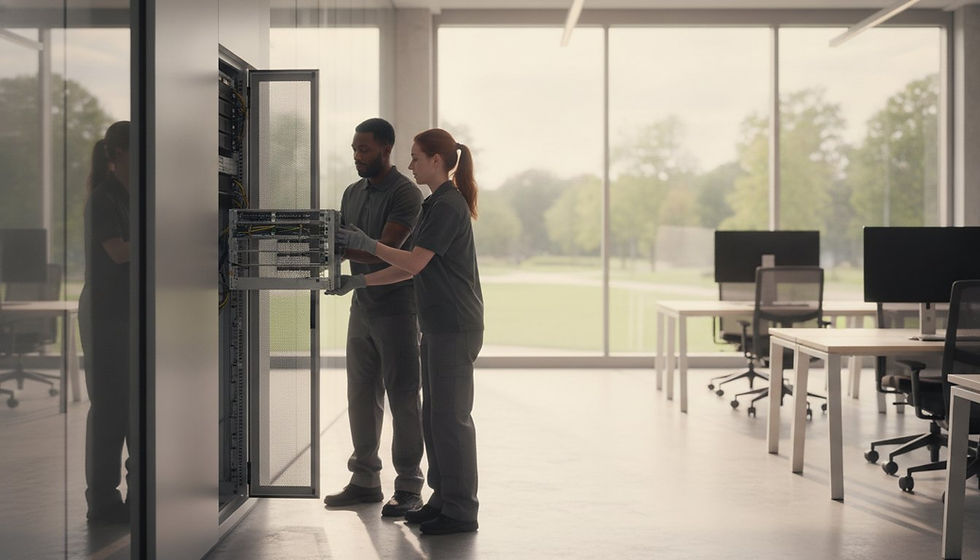
The critical path for server migration involves the precise sequence of decommissioning, secure transit, and immediate re-installation to ensure core business functions resume without delay. To protect this delicate hardware, we use specialised "techno-crates" and anti-static packing materials that prevent electrostatic discharge from damaging sensitive components. It's vital to coordinate these movements with your ISP to maintain a steady connection for remote-access employees who rely on these servers during the physical move. By treating your servers as the priority "precious cargo," you ensure that the digital heart of your company remains unobstructed throughout the transition.
Compliance and Data Protection
In the 2026 regulatory landscape, the stakes for data security have never been higher. With the Information Commissioner's Office (ICO) now able to issue fines of up to £17.5 million or 4% of global turnover for breaches, maintaining a secure chain of custody is essential. Every data-bearing asset, from laptops to external drives, must have a documented audit trail during transit. This protection extends to physical files and archival storage, which require the same level of security as your digital assets. When choosing a removal partner, you should vet them for enhanced security clearances and comprehensive insurance that specifically covers high-value technology and sensitive data. This layer of transparency builds the trust you need to move forward without fear of a compliance failure.
Executing the Physical Move: Logistics and Employee Transition
The physical move is the culmination of months of preparation. It's the moment your office relocation project plan uk shifts from a digital document to a fleet of vehicles and a team of experts. Managing this transition requires more than just muscle; it demands a surgical approach to logistics to ensure that every department lands exactly where it needs to be. By focusing on the final 48 hours and the immediate aftermath, you can protect your staff from the typical "moving day" chaos and maintain business continuity.
Your strategy for the final weekend must be airtight. This period involves the heavy lifting of decommissioning the old site and the rapid setup of the new "Day One" environment. It's a high-pressure window where clear communication and structured workflows are your best tools. By implementing a system that prioritises departmental placement and technical readiness, you ensure that your team can walk in on Monday morning and get straight to work without hunting for their equipment or struggling with connectivity.
The Labelling and Placement Strategy
Precision in placement starts with a robust labelling system. We recommend a colour-coded approach where each department is assigned a specific hue, paired with sequential numbering that maps every crate to a specific desk on the master floor plan. This allows the removal team to navigate the new site with total autonomy, placing equipment exactly where it's needed without constant supervision. It prevents the frustration of "lost" items and ensures a steady, unobstructed progression through the building.
During the packing phase, it's helpful to distinguish between "Company Property" and "Personal Effects." Provide your team with specific packing materials and clear instructions on what they should manage themselves. A master floor plan, displayed at the entrance of the new site, serves as the ultimate guide for the removal team. This ensures that fluid movement is maintained throughout the day and that every piece of furniture is positioned correctly according to your pre-approved design.
Day One: Ensuring a Positive Employee Experience
The first morning in a new office sets the tone for the months to follow. To achieve a seamless start, ensure that refreshment stations and functional breakout areas are ready before the first person walks through the door. Small touches like "Welcome Packs" containing floor plans, local area guides, and new security passes can significantly reduce first-day confusion. We also suggest deploying an IT "Roam Team" to walk the floor and assist with any workstation snags or peripheral issues.
Establishing a temporary "Help Desk" to resolve immediate snags is a final, vital step in your plan. This proactive support proves to your team that their comfort and productivity were prioritised throughout the move. A well-organised first day in the new office provides deep psychological reassurance, turning a potentially stressful transition into an exciting milestone for the whole company. If you want to ensure this level of care for your next move, our professional office removals service is designed to handle every detail with precision and empathy.
Partnering for Success: How Goldfish Moving & Storage Manages Your Commercial Move
A successful relocation is the result of a partnership built on trust and technical expertise. While the previous chapters of this guide have outlined the milestones of an office relocation project plan uk, the physical execution requires a team that shares your commitment to business continuity. With over 10 years of professional removal experience, we've refined our approach to handle the unique pressures of commercial moves. We don't just move boxes; we manage a transition that protects your reputation and your bottom line.
Our office removals service is designed to be as flexible as your business needs. We provide expert packing and specialist handling for IT infrastructure, ensuring that high-value equipment is shielded from the risks of transit. This controlled efficiency is central to our philosophy. It allows us to move complex environments while you focus on maintaining your service levels. Whether you're moving a small team or a large corporate headquarters, our methods ensure a steady, unobstructed progression toward your new Day One.
Sometimes, a move doesn't happen all at once. Phased relocations or the need to right-size your furniture can create a gap between leaving the old site and fully occupying the new one. Our flexible storage solutions provide the breathing room you need during these transitions. We offer secure, managed facilities that act as an extension of your own workspace, keeping your assets safe until you're ready for them. This level of individual care is what sets a boutique service apart from a standard logistics provider.
The Goldfish Moving & Storage Advantage: Professionalism and Precision
We believe that clarity is the best antidote to relocation anxiety. That's why we've developed a transparent, fixed-fee quoting process specifically for our corporate accounts. You won't find hidden surcharges or unexpected variable rates here. Instead, you'll receive a detailed breakdown that allows you to budget with total confidence. Our capability extends across the entire United Kingdom, allowing us to manage national relocations with the same local attention to detail that our clients have come to expect. We treat every item, from a boardroom table to a delicate server, as a precious asset that deserves our full protection.
Your Dedicated Move Coordinator
The success of your office relocation project plan uk rests on the shoulders of your Dedicated Move Coordinator. This professional acts as your primary point of contact, translating your strategic goals into logistical reality. They bridge the gap between your HR objectives and our physical expertise, ensuring that every detail of your plan is executed to the letter. By acting as a single, knowledgeable anchor for your project, they lower the stress levels of your entire committee. If you're ready to start your journey with a team that values precision and kindness, Contact Goldfish Moving & Storage for a Bespoke Office Relocation Quote today.
Securing Your Business Future Through Strategic Relocation
A successful relocation is the result of foresight and meticulous attention to detail. By establishing a clear 12-month timeline and managing your lease obligations early, you protect your company from the financial sting of dilapidations and operational delays. Your office relocation project plan uk must prioritise technical resilience, ensuring that IT migration and data security align with the latest 2026 regulations. When you focus on a structured transition, you don't just move desks; you build a foundation for your team's next chapter of growth.
We've spent over 10 years perfecting the art of professional removals, developing a national reach that spans the entire United Kingdom. As specialists in IT and high-value asset relocation, we understand the delicate balance between logistical speed and equipment safety. We're here to act as your primary protector, replacing moving-day anxiety with a sense of calm, controlled efficiency.
Frequently Asked Questions
How far in advance should we start planning our UK office relocation?
You should begin the process at least 12 months before your current lease expires. This timeframe allows for a comprehensive office relocation project plan uk businesses can use to manage property searches, legal negotiations, and dilapidation surveys. Starting early ensures that you aren't rushed into decisions that could lead to operational friction or budget overruns as your move date approaches.
What is the average cost of an office move for a UK business?
Industry data for 2026 suggests that a typical office move can range from £3,500 to over £23,000 depending on the scale and complexity. Most businesses spend between £75 and £220 per employee for a professional relocation. These estimates vary based on the volume of IT equipment, the distance of the move, and the level of packing services required to protect your assets.
How do we ensure GDPR compliance when moving office hardware?
You must maintain a secure, documented chain of custody for every data-bearing device during the transition. This involves using audit trails to track the movement of laptops, servers, and hard drives from the old site to the new one. Vetting your removal partner for enhanced security clearances and ensuring they follow the 2026 data protection standards is vital to prevent costly compliance breaches.
What are dilapidations, and how do they affect our relocation project plan?
Dilapidations are the repairs or redecorations required to return a leased property to the condition specified in your original contract. These obligations can represent a significant financial burden, so your office relocation project plan uk should include a professional survey at least nine months before your exit. This allows you to budget for repairs or negotiate a settlement with your landlord well in advance.
Should we use a lump sum or a managed move approach for our office relocation?
A managed move approach is generally superior for businesses that prioritise business continuity and risk mitigation. While a lump sum quote provides a single price, a managed move includes a dedicated coordinator who oversees the technical details of the relocation. This professional guidance helps you avoid the hidden costs of downtime and ensures that every department is set up correctly on Day One.
How can we minimise business downtime during a national office move?
Scheduling the physical move over a weekend is the most effective way to ensure your operations remain unobstructed. You should also ensure that all IT connectivity and phone lines are tested and live at the new site before the removal team arrives. Providing staff with clear "Welcome Packs" and floor plans also helps them settle in quickly, allowing productivity to resume immediately on Monday morning.
What insurance coverage is required for a commercial office relocation?
Your removal partner must provide robust Goods in Transit insurance and Public Liability coverage to protect your assets and the premises. You should also verify that your own business insurance remains valid during the transition period. Always check that the policy limits reflect the full replacement value of your high-value IT infrastructure and specialised equipment to avoid any financial shortfalls.
Do we need to hire a professional project manager for a small office move?
Small moves for 5 to 15 employees can often be managed by a dedicated internal lead if they have a structured roadmap to follow. However, even for smaller teams, the technical risks of moving servers and sensitive data often justify professional support. Partnering with an expert removal team provides the logistical framework you need to ensure the move is handled with precision and care.


Comments