
Fine Art & Antique Moving Surrey: The Expert Guide to Protecting Your Collection (2026)

Did you know that accidental damage during transit accounts for approximately 50% of all fine art insurance claims? It's a sobering figure that explains why a standard removal service often feels like a risk when it comes to your most cherished possessions. If you're preparing for a relocation, the thought of an irreplaceable heirloom being mishandled is likely your biggest source of stress. This is why fine art & antique moving requires a level of precision engineering and chemical-safe materials that go far beyond traditional packing.
We understand that these items aren't just assets; they're the tangible history of your home. You need to know that your collection is protected by more than just basic wrapping. This guide will show you exactly how to achieve a zero-damage relocation by using professional standards and bespoke crating techniques. We'll also clarify the 2026 insurance landscape and the latest UK regulations, giving you the professional validation and absolute peace of mind you deserve for your move across Surrey.
Key Takeaways
Understand why fine art & antique moving requires specialised vibration dampening and environmental controls that standard removal equipment simply cannot provide.
Learn about the multi-layered packing process and the specific role of acid-free materials in preventing chemical bonding with historic finishes.
Identify the critical differences between standard liability and specialist transit insurance to ensure your high-value items are fully protected.
Master a practical preparation checklist, including how to document your inventory and coordinate with insurers before the relocation begins.
Discover the benefits of a family-run, white-glove service that prioritises personal accountability for collections in Sunningdale, Weybridge, and beyond.
Table of Contents
The Unique Challenges of Fine Art & Antique Moving
Relocating a household is a significant task, but fine art & antique moving is a distinct logistics discipline that requires far more than just heavy lifting. It is a process rooted in the science of preservation. Whilst a standard removals company might offer "extra care," they often lack the technical infrastructure to manage the specific environmental controls and vibration dampening necessary for high-value collections. In a moving vehicle, even minor road vibrations can cause microscopic stress fractures in aged wood or brittle paint layers if the items aren't properly decoupled from the van's floor.
Standard removals equipment is often insufficient for historic finishes and delicate canvases. Most modern packing materials are designed for durability rather than chemical neutrality. For collectors, the danger often comes from "invisible threats" that occur during transit. Thermal shock, for instance, happens when an item moves from a heated gallery to a cold loading bay, causing materials to expand or contract at different rates. This can lead to immediate damage that isn't visible until weeks later. We distinguish between "fragile" items, which can often be replaced, and "irreplaceable" antiques that carry unique historical and emotional weight. This is why professional art handlers treat every object as a singular project with its own set of biological and structural needs.
Material Sensitivity: Beyond the Surface
The chemistry of your collection is just as important as its physical shape. Oil paints, gold leaf, and French-polished wood are highly reactive. They don't just sit on a surface; they interact with the air around them. Using standard plastics or acidic cardboards can lead to disastrous results, such as "ghosting" on a canvas or clouding a delicate finish. We are particularly cautious about off-gassing, which is the release of volatile organic compounds from synthetic packing materials that can yellow varnish or degrade pigments during a journey. To prevent this, we use only pH-neutral barriers that won't bond with the artwork, regardless of the transit time.
Structural Vulnerabilities in Antique Furniture
Antique furniture relies on traditional dowel joints, marquetry, and aged animal-hide glues that become increasingly brittle over the centuries. Unlike modern furniture, which is often uniform in its strength, an antique piece has specific "lifting points" that must be identified before it is moved. Lifting a period chair by its arms rather than its seat rail, for example, can cause the joints to fail instantly. Items with internal movements, such as grandfather clocks, require even more specialised attention. We ensure that weights are removed and pendulums are secured to prevent internal kinetic damage, stabilising the piece from the inside out before it even reaches the van.
Bespoke Packing and Crating: The Science of Protection
The safety of your collection depends on a multi-layered approach to protection. We don't just wrap items; we engineer a shield that accounts for soft-wrapping, shock-absorption, and external shielding. This is the cornerstone of effective fine art & antique moving. By creating distinct layers, we ensure that the physical item is isolated from external pressures, vibrations, and temperature fluctuations. Every layer serves a specific purpose, moving from the delicate surface of the piece to the rigid exterior that guards against the bumps of the road.
Chemical safety is the first line of defence. Standard packing materials often contain acids that can leach into canvases or wood finishes over time. To prevent this, we use acid-free tissue and Glassine paper. Glassine is particularly effective because it is air, water, and grease resistant, ensuring that no chemical bonding occurs between the wrapping and the art surface. These methods align with the Professional Guidelines for Moving Collections, which emphasise the need for pH-neutral barriers to maintain the integrity of historic artefacts. It is this attention to the microscopic level that prevents long-term degradation during a move.
For local relocations within Surrey or Hampshire, a high-specification soft-wrap is often sufficient. We use specialised "Blue Wrap" or thermal blankets for temperature-sensitive items to mitigate the risks of thermal shock. However, when the journey involves international shipping or high-risk handling, we transition to bespoke crating. If you're unsure which level of protection your collection requires, our team can help you organise the correct packing services for your specific needs, ensuring a tailored fit for every item.
The Anatomy of a Bespoke Shipping Crate
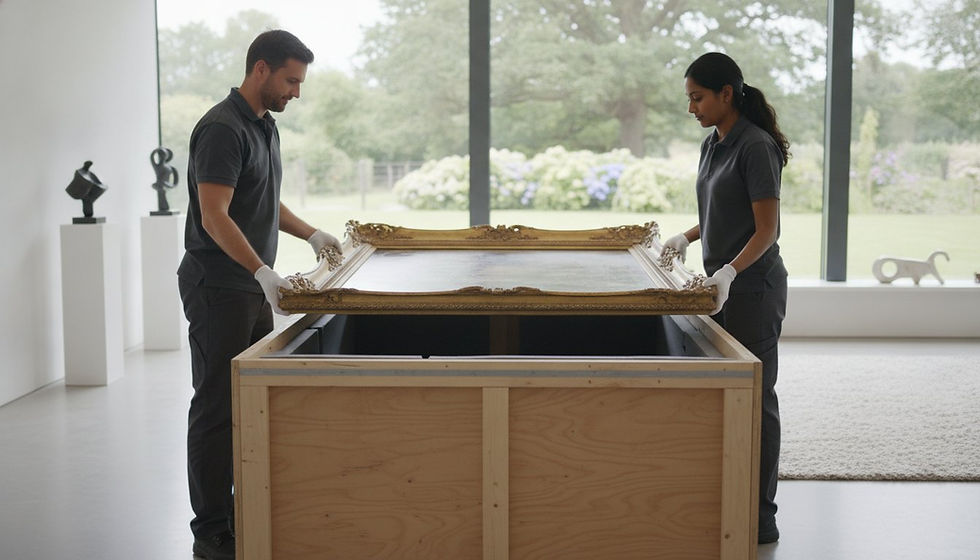
We construct museum-grade plywood crates tailored to the exact millimetre of your item. These aren't just wooden boxes. They feature internal foam "float" systems that suspend the item within the crate, effectively decoupling it from the outer shell. This suspension is essential for complex items like chandeliers or large-scale sculptures, where traditional pressure-packing could snap delicate protruding elements. The crate acts as a secondary environment, providing a stable micro-climate for the contents.
Specialised Materials for Fine Art
Standard bubble wrap is often unsuitable for fine art because it can trap moisture or create static. Instead, we utilise anti-static, non-abrasive alternatives that protect sensitive electronic components or gilded frames. For heavy canvases, we employ corner protectors and "T-frames" to ensure the weight is distributed through the frame rather than the fabric. Because every collection is unique, Goldfish organises high-quality packing materials specifically for fine art clients, ensuring that every layer of the science of protection is applied with absolute precision.
Assessing Value and Managing Risk: Insurance and Surveys
Understanding the true value of your collection is the first step in protecting it. A standard removals quote often fails to account for the specific risks associated with fine art & antique moving, which is why a professional pre-move survey is essential. We don't just look at the volume of boxes; we assess the structural integrity of each piece and the logistical path it must take. Identifying high-risk items early allows us to prepare the necessary bespoke crating and handling strategies before the move day arrives.
Documentation acts as your secondary shield. Before a single piece is wrapped, we recommend creating a comprehensive condition report supported by high-resolution photography. This creates a definitive "point in time" record that protects both you and the mover. Whilst some might baulk at the cost of specialist services, the financial and emotional toll of a failed restoration is invariably higher. Investing in professional handling is a proactive choice that prioritises the long-term preservation of your legacy over short-term convenience.
The Importance of a Technical Survey
Surrey is home to many stunning period properties, yet their narrow stairwells and historic doorways present significant challenges for moving large or heavy antiques. During a technical survey, we identify these access bottlenecks and plan for specialised equipment like floor runners to protect original parquet or furniture hoists for upper-floor access. Goldfish provides a reassuring, fixed-fee quote after this thorough assessment, ensuring there are no hidden surprises or logistical delays on the day of your relocation.
Navigating Fine Art Insurance
The insurance landscape for 2026 is currently in a "soft" phase, which means there is increased competition amongst insurers to offer flexible and generous terms. However, it's vital to distinguish between "Transit Insurance" and "Standard Liability." Standard removals liability often covers items by weight, which is wholly inadequate for a 17th-century oil painting. You should look for "new for old" coverage or agreed-value indemnity that reflects the current market price. For items exceeding specific value thresholds, such as the £50,000 mark often seen in the industry, a professional valuation may be required by your provider. We always advise keeping original certificates and provenance documents in a separate, secure folder that travels with you personally, rather than inside the removals van.

Preparing Your Collection for Relocation: A Homeowner’s Checklist
Whilst the logistics team handles the technical execution, your personal preparation ensures the transition remains seamless. Taking an active role in the lead-up to move day provides an extra layer of security for your collection. Effective fine art & antique moving relies on a partnership between the owner and the specialist team, beginning with a clear, organised plan of action. Following a structured checklist helps eliminate the "move-day fog" and ensures nothing is overlooked during the excitement of a relocation.
Conduct an independent inventory: Create a detailed log of every piece. Take high-resolution "before" photographs from multiple angles, focusing on existing joints, surfaces, and any previous repairs.
Consult your insurer: Confirm your coverage limits for the transition period. Ensure they are satisfied with the chosen transport methods and the inventory documentation you've prepared.
Organise professional cleaning: If a piece is structurally unstable or heavily soiled, consider a professional restoration or cleaning before the move. Dust and grime can act as abrasives under packing materials if not addressed.
Separate smaller valuables: Items such as jewellery, small silver pieces, or coin collections should be kept aside. We recommend transporting these personal treasures in your own vehicle for continuous oversight.
Establish "no-touch" zones: Upon our arrival, clearly communicate which areas or items require specific handling or should be left until last. Using physical markers or coloured tape can help the team identify these zones instantly.
If you have specific concerns about your most delicate items, you can book a specialist packing consultation to discuss bespoke solutions before the move begins.
What to Ask Your Specialist Mover
Don't be afraid to be inquisitive. You should verify that your team has direct experience with your specific types of items. For example, ask if they have moved a Steinway piano or a large-scale contemporary installation before. It's also vital to ask about their staff training. At Goldfish, we prioritise personal accountability, so you should check if the movers are permanent, trained employees or temporary agency staff. Finally, enquire about the security features of their vehicles, such as GPS tracking and climate-control capabilities.
Managing the Environment Post-Move
The journey doesn't end when the van is unloaded. We recommend a period of "acclimatisation" for your collection. Avoid unwrapping oil paintings or delicate wood pieces immediately; let them sit in their packaging for a few hours to reach the ambient temperature of the new room. When choosing where to place your antiques, keep them away from direct sunlight or active radiators, as sudden heat can cause aged wood to warp. For mechanical antiques like grandfather clocks, allow a "settling period" of 24 hours before restarting the movement to ensure all internal components have stabilised after the vibration of transit.
Why Choose Goldfish Moving & Storage for Your High-Value Items
Choosing a partner for fine art & antique moving is a decision rooted in trust. At Goldfish Moving & Storage, we don't view your collection as mere inventory. We see it as the Fish family sees our own history: irreplaceable and deserving of absolute care. Being a family-run business based in Farnborough, we offer a level of personal accountability that larger corporations simply cannot match. When you speak to us, you're talking to professionals who have spent over a decade perfecting the art of the stress-free move across Surrey and Hampshire.
Our experience in high-end areas like Sunningdale, Weybridge, and Ascot has taught us that every project requires a unique blueprint. We've handled everything from single, high-value canvases to entire estate relocations with a focus on controlled efficiency. Our goal is to lower your anxiety by providing a warm, person-centred service that anticipates every logistical hurdle before it arises. We replace the typical industry-related worry with a sense of calm, ensuring that your transition feels like a steady, unobstructed progression.
Local Knowledge, Global Standards
Our strategic location near regional antique hubs and major London auction houses allows us to provide a rapid, highly personalised service. We understand the specific requirements of the local market, yet we maintain global standards of protection. Whether you are moving a single piece within Virginia Water or require international removals for an overseas transition, we ensure the same rigorous standards of care. Our Aldershot and Farnborough bases serve as the perfect launchpad for secure transit across the home counties and beyond, giving you the benefit of local expertise with a global reach.
The Goldfish Guarantee of Care
We provide a comprehensive end-to-end service designed to remove the burden of relocation from your shoulders. From the initial technical survey to the final placement in your new home, our team manages every detail with precision. This includes everything from bespoke crating for delicate sculptures to secure, climate-monitored storage solutions if your new gallery space isn't quite ready. We invite you to engage in a personal dialogue with us to discuss your collection's specific needs and experience the kindness and organisation that defines our service.
Ensuring a Seamless Transition for Your Heirlooms
Relocating precious heirlooms doesn't have to be a source of anxiety. By understanding the science of vibration dampening and the critical role of pH-neutral materials, you've already taken the first step toward a zero-damage move. Successful fine art & antique moving relies on this marriage of technical protection and thorough administrative preparation. From conducting your own high-resolution inventory to ensuring your transit insurance reflects current 2026 market valuations, these proactive details transform a high-stakes transition into a managed, predictable process.
As a family-run business with over a decade of experience, Goldfish Moving & Storage provides the personal accountability your collection deserves. Our dedicated white-glove art handling team uses bespoke in-house crating to protect every delicate joint and sensitive finish across Surrey and Hampshire. We're here to replace the typical logistical burden with controlled efficiency and genuine kindness, treating your history as if it were our own. When you're ready to move your most valued possessions with absolute peace of mind, we invite you to Request a Professional Fine Art & Antique Moving Quote. We look forward to helping you settle your treasures into their new home safely.
Frequently Asked Questions
How much does it cost to move fine art and antiques in Surrey?
Pricing for fine art & antique moving is provided through a bespoke, fixed-fee quote following a detailed technical survey. Because every collection has unique requirements, we don't use standard rate sheets. The final cost depends on the fragility of the items, the need for custom-built timber crates, and any specific access challenges at your Surrey property.
Do I need a specialist for moving a piano or grandfather clock?
Yes, items with complex internal mechanisms require specialist handling to prevent mechanical failure. Pianos involve significant weight and tension; whilst grandfather clocks must be dismantled and stabilised to protect the pendulum and weights. Our dedicated white-glove team has over a decade of experience in managing these specific structural vulnerabilities, ensuring your instruments arrive in perfect working order.
What is bespoke crating, and is it necessary for my move?
Bespoke crating involves the construction of museum-grade timber housing tailored to the exact dimensions of your item. It is essential for high-value pieces, large sculptures, or items being transported internationally. These crates feature internal "float" systems that suspend the object, providing a secondary layer of protection against the vibrations and pressures of long-distance transit.
Is my artwork insured during the move with Goldfish?
We offer comprehensive transit insurance that provides far greater protection than standard removals liability. During your pre-move survey, we'll discuss your collection's value and ensure the coverage limits are appropriate for your specific pieces. This specialist insurance is designed to cover the full replacement or restoration value of your high-value items, giving you absolute peace of mind.
How far in advance should I book a fine art removal service?
We recommend booking your service at least four to six weeks before your move date. This timeframe allows us to conduct a thorough technical survey and construct any necessary bespoke crates. Planning ahead ensures that we can dedicate our most experienced art handlers to your project and secure any specialised equipment needed for a zero-damage relocation.
Can you transport large art collections internationally from the UK?
Our team manages complete international relocations for fine art collections, including all customs formalities and shipping logistics. We navigate the current 2026 regulations, such as EORI requirements and import VAT declarations, to ensure a smooth transition between the UK and your destination. This end-to-end service includes everything from export-standard packing to secure delivery at your new global residence.
What materials do you use to protect oil paintings from smudging?
We use pH-neutral Glassine paper as the primary barrier for oil paintings to prevent smudging or chemical bonding. Glassine is air and water-resistant, which protects the delicate surface of the paint whilst allowing it to breathe. This is often followed by a layer of acid-free tissue and shock-absorbent materials to create a stable micro-climate that guards against environmental shifts during fine art & antique moving.


Comments